VPH Executive Committee Interview Series: Michèle Barbier on Ethics, Trust and Responsible In Silico Medicine
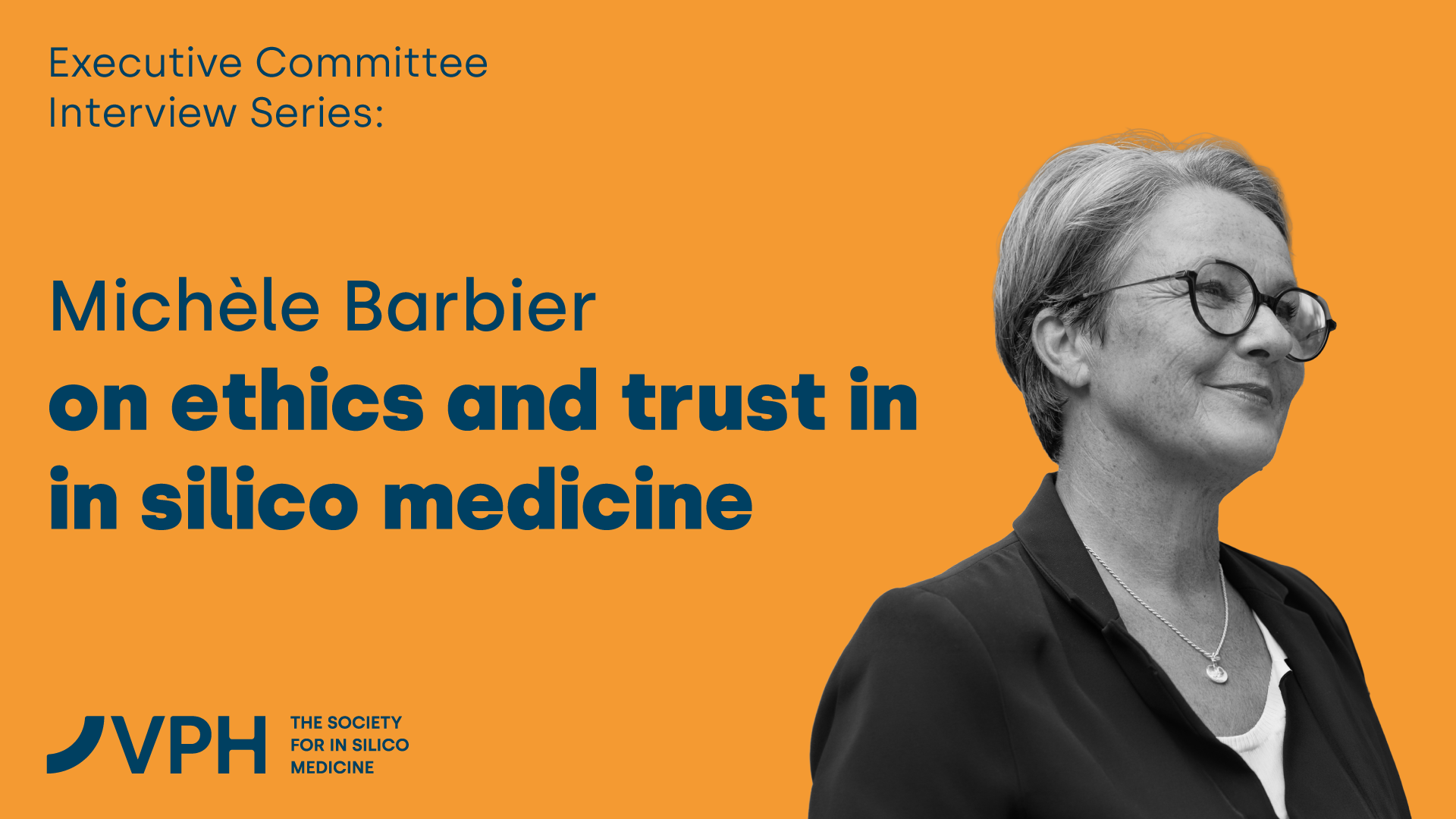
In the latest edition of the VPH Executive Committee Interview Series, we speak with Michèle Barbier, a leading voice at the crossroads of ethics, digital health, and social science. As in silico medicine accelerates the development of digital twins and AI-driven models in healthcare, ethical reflection is no longer optional; it is foundational.
From data sovereignty and algorithmic fairness to clinical validation and public engagement, Barbier argues that ethics is not a brake on innovation but its compass. Without transparent governance, inclusive validation, and patient-centered design, even the most advanced digital health technologies risk undermining trust and widening inequalities.
- You have long been active at the intersection of ethics, digital health, and social science. How can ethical reflection strengthen the development and acceptance of in silico medicine across research, clinical practice, and society?
Innovation and ethics aren’t just connected — they’re inseparable. Technological progress without ethical reflection doesn’t just risk inefficiency — it risks deepening inequality, eroding patient autonomy, and causing real, unintended harm. And that’s especially true in in silico medicine.
We are talking about digital simulations of the human body — tools that can predict disease, test treatments, and personalise care before a single pill is ever prescribed. That’s powerful. But with that power comes responsibility. As these tools move from research labs into clinics and public health systems, they must be guided by clear ethical principles: patient safety, data sovereignty, algorithmic fairness, and equitable access — not just technical accuracy.
Without that grounding, we risk amplifying existing biases, sidelining clinician judgment, or excluding vulnerable populations — not because the technology is bad, but because we did not design it with ethics at the core.
Ethical innovation means thinking ahead — anticipating long-term consequences, centering human dignity, and being radically transparent about what these tools can — and cannot — do. It means bringing together scientists, clinicians, regulators, and patients to co-create systems that earn trust, not just compliance.
Ethics isn’t a brake on innovation — it’s its compass. It doesn’t slow us down; it steers us toward what truly matters — societal benefit, not just efficiency or profit. Because true progress isn’t measured by how much we can simulate… but by whether we deploy it wisely, justly, and for the common good.
- Many of your activities focus on building trust in digital health technologies. In your view, what are the most important steps the in silico medicine community should take to ensure that digital twins and AI systems are perceived as reliable and responsible tools?
Trust is the foundation — without it, even the most advanced tools will be rejected by clinicians, patients, and regulators. In digital health, where AI and digital twins directly influence diagnosis and treatment, trust isn’t optional — it’s the prerequisite for real-world impact.
So, to build that trust, we need to act at every level. First, transparency must be built in from day one: explain how these systems work, what data they use, and where their limits lie — no black boxes.
Second, validation must be clinical and inclusive. These tools must be tested against real patient outcomes — using diverse, representative datasets — and must meet regulatory standards like the EU MDR or FDA’s guidelines. If they’re not safe, traceable, and fair, they do not belong in clinical practice.
Third, equity cannot be an afterthought. We must actively include underrepresented groups in training data and co-design — and then audit for bias, because a tool that works for one population but fails another isn’t just unfair — it’s dangerous.
Fourth, human judgment must remain central. These aren’t replacements for clinicians — they are collaborators. Interfaces should support, not override, professional expertise and patient autonomy.
Fifth, governance must be clear: who’s accountable when something goes wrong? We need audit trails, incident reporting, and redress mechanisms — not just for compliance, but for trust.
And public engagement matters. We need to educate patients, clinicians, and policymakers — not just about what these tools can do, but about their limits. Trust is built through honest, accessible dialogue — not marketing.
And finally, research should prioritise societal risk, not just technical novelty. And data sovereignty — through federated learning, GDPR compliance, and patient control — must be non-negotiable.
In short: trust isn’t granted. It’s earned — through consistent, visible, and verifiable responsibility at every stage — from the lab bench, to the clinic, to society.
- You are currently contributing to ethical frameworks for digital twins in healthcare, including, for instance, initiatives with the French Ministry of Health. How do these efforts help create a common foundation for responsible innovation in in silico medicine?
These efforts — including my work with the Digital Health Ethics Unit at the French Ministry of Health — help create a common foundation for responsible in silico medicine by turning ethical principles into actionable, shared frameworks.
Based on EDITH road map, we help defining what digital twins are — and more importantly, what they aren’t: not duplicates, but dynamic, partial models that must never replace human judgment or reduce patients to data. This shared language prevents dangerous assumptions and guides developers, clinicians, and regulators alike.
We’re mapping ethical risks — from bias and consent to environmental impact — and proposing concrete governance tools: co-ownership of data, explainable models, evolving consent, and sustainability-by-design.
Most importantly, we’re building this foundation together — with engineers, ethicists, clinicians, and patients — ensuring that innovation does not outpace responsibility. Ethics is not a barrier — it’s the infrastructure that allows in silico medicine to scale with trust, equity, and purpose.
- At the upcoming VPH2026 Conference in Milan, you will be chairing a session on “Trusted AI and Modelling in Health and Care: Ethical, Legal and Societal Dimensions”. Who would you invite to contribute, and what impact do you hope these discussions will have on researchers, clinicians, and patient representatives participating at the conference? event?
I am inviting the full spectrum of actors shaping the future of in silico medicine: researchers and engineers — the first builders of digital twins and AI models — because they must be the first to ask, “What are the long-term consequences of what we’re creating?” I would also invite social scientists and philosophers to challenge assumptions, clinicians to ground discussions in real-world care, and patient representatives — because no innovation is trustworthy if it doesn’t reflect the people it’s meant to serve.
My hope is that these discussions will shift perspectives:
– For researchers, I want them to see ethics not as a constraint, but as a design requirement — one that makes their work more robust, responsible, and ultimately more impactful.
– For clinicians, I want them to feel empowered to question, adapt, and co-shape the tools they use — so they remain in control of care, not algorithms.
– For patient representatives, I want them to know their voice is not an afterthought — it’s the compass that should guide innovation from day one.
Ultimately, I hope this session helps turn “trusted AI” from a buzzword into a lived practice — where technology is built with people, not just for them — and where every stakeholder leaves not just informed, but inspired to collaborate across disciplines to build a future of in silico medicine that is not only advanced — but truly ethical, equitable, and human-centered.
- Looking ahead, what would you like to see from the in silico medicine community, and from VPH in particular, to ensure that ethical, legal, and societal considerations remain at the core of technological progress?
Looking ahead, I would like to see the in silico medicine community – and VPH in particular – embrace a model of “ethics by design” rather than “ethics by repair.” That means building ethical, legal, and societal reflection into every step of the research and innovation process, not treating it as an add-on once the models are built. VPH is already creating sustained spaces for dialogue with patients, clinicians, ethicists, regulators, and civil society – not only to explain VPH technologies, but to let these stakeholders shape priorities, standards, and acceptable uses.
Future concrete commitments for VPH could be: positioning itself as a global hub for responsible innovation: a place where technical excellence is systematically paired with work on fairness, transparency, accountability, and patient empowerment. It could also means championing open, scrutinizable practices around data governance, model validation, and impact assessment, so that questions like “Who benefits?”, “Who is left out?” and “Who is accountable when things go wrong?” are explicitly addressed.
If VPH can lead on these fronts, it will help ensure that the most advanced in silico medicine is not merely the most complex computationally, but the most trustworthy and socially responsive – one that advances care while protecting rights, reducing inequities, and strengthening public confidence in digital health.