VPH Executive Committee Interview Series: Prof. Pinaki Bhattacharya on Engagement with Societies
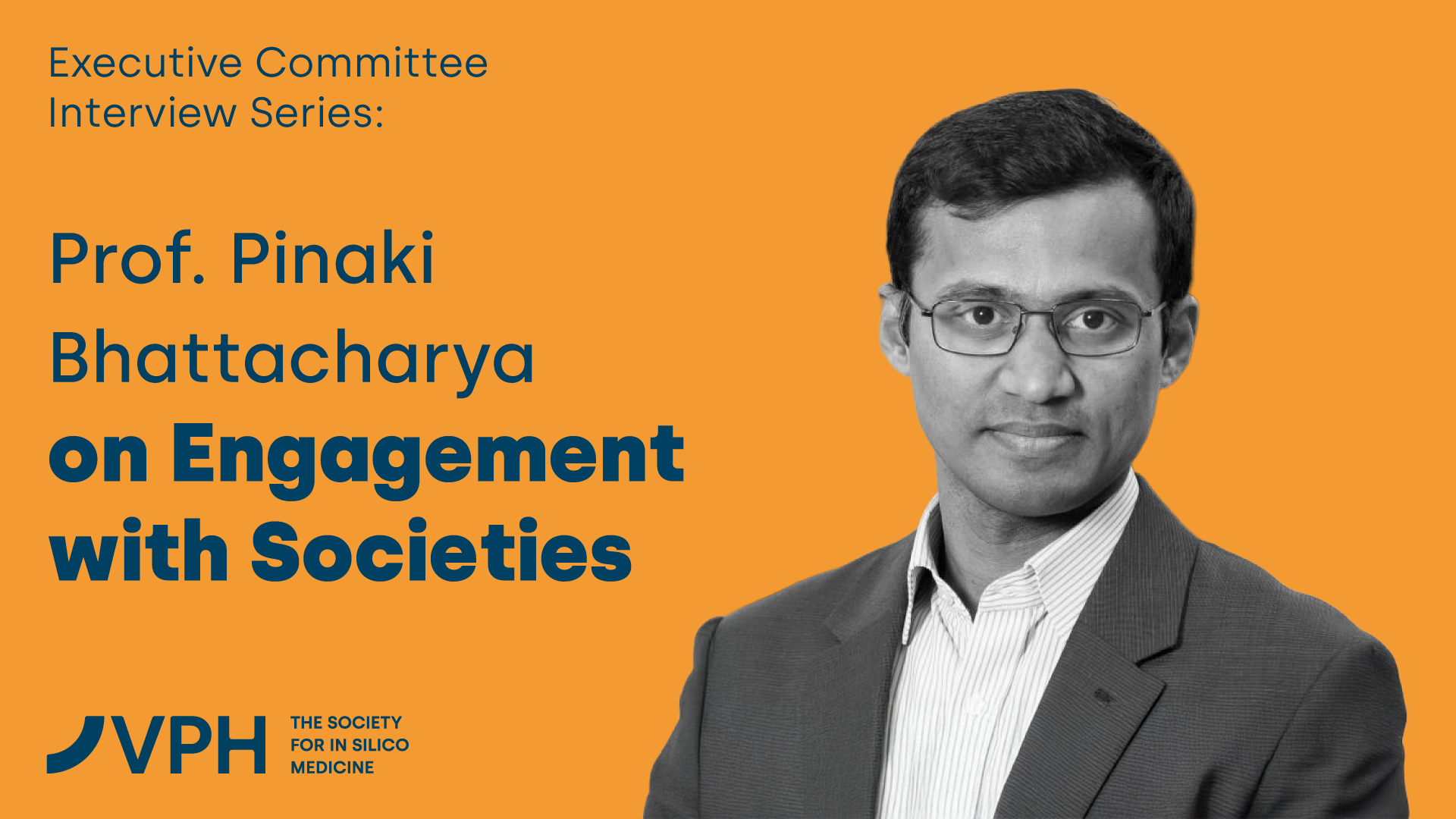
In silico medicine is transforming healthcare by combining computational modelling, data, and clinical insight to predict, prevent, and personalise medical interventions. In this new interview for the VPH Executive Committee Interview Series, we speak with Prof. Pinaki Bhattacharya, Associate Professor of Solid Biomechanics at the Insigneo Institute, University of Sheffield, about the strategic importance of interdisciplinary collaboration, the future of musculoskeletal modelling, and the growing role of in silico methods in clinical decision-making and regulation.
From strengthening ties with scientific societies worldwide to advancing predictive models for osteoporosis and fracture risk, Prof. Bhattacharya shares his vision of how in silico medicine can become an integral part of healthcare in the coming decades. He also reflects on education, regulation, and the critical role VPH plays in shaping a connected, inclusive, and forward-looking ecosystem for digital health innovation.
- Your role in the VPH Executive Committee focuses on fostering engagement with other scientific societies. Why do you think these collaborations are important for advancing in silico medicine, and which communities do you believe VPH should connect with more closely to strengthen its impact?
As we know, in silico medicine refers to the use of computer modeling and simulation to solve healthcare problems. This makes it an inherently interdisciplinary area of research. To realise the impact of an in silico medicine solution, a robust chain of collaborations across diverse scientific disciplines must materialise. For instance, in my own research on bone disease, we need medical imaging to provide accurate data, mechanical modelling to simulate events such as falling, high-performance computing to execute complex simulations efficiently, and clinical guidelines for effective use of these tools in practice. VPH, as a society, has a key strategic role in initiating, developing, and strengthening these vital collaborative networks, and without these, impact cannot be achieved.
I am focusing on connecting links with societies that can support the foundational science and methodological rigour underpinning in silico medicine. This includes societies involved in biomedical engineering generally, to those focused on high-performance computing, novel imaging techniques, experimental validation approaches. I am keen to expand the geographical spread of the VPH network. At the same time, I am working with my colleagues who are reaching out to clinical societies, regulatory bodies and the industry, and I believe this joined up approach can strengthen the impact of in silico medicine.
- VPH is still a relatively new society, focusing on a highly interdisciplinary and rapidly evolving field such as in silico medicine. From your perspective, what can we do to strengthen our network and improve our connections?
As a relatively new society, I believe we should identify the processes that have been successful until now to improve our connections and make these processes stronger. VPH has already established memoranda of understanding (MoUs) with societies and this could be a template we can strengthen further. Interdisciplinary PhD awards, awarded jointly with other societies, parallel sessions in the annual conferences we seek to connect with, inviting other societies to participate in VPH conferences, hosting webinars from experts in other societies on VPH website, are some of the other directions I am pursuing. The other thing of course to do is to regularly check in with our membership and the VPH board of directors whether this approach is working, or look to new ideas for improving our connections. I look forward to hearing from VPHi members, and if anyone has any feedback on what we could do more, or wants to connect us with a society they have established links with, or anything in between, they are welcome to email me at p.bhattacharya@sheffield.ac.uk.
- Having worked across multiple institutions and countries, how have these diverse environments shaped your approach to research and collaboration
My experiences made me aware early on that different parts of the world for a mix of historic and cultural reasons have different, and often implicit, worldviews that influence all research, not only in silico medicine research, that operates in that region. This influence determines everything from research questions one is encouraged to ask to the rate at which that research area can advance. One can readily identify some tangible aspects of such influence that are particularly relevant to in silico medicine. These include availability of data, funding to support underlying research, costs and provisioning of healthcare, regulation of innovative solutions, and so on. I have been further sensitised to these differences in worldviews thanks to my personal experiences in navigating healthcare systems in the places I have lived and worked, including India, the US, Belgium and the UK. Overall, this has made me adaptive to change when collaborating internationally, and excited about the possibility that such collaboration could, in some instances, be exactly the thing you need to advance a particular research project or direction.
- Your research focuses on predicting the efficacy of medical interventions in musculoskeletal diseases such as osteoporosis. How can in silico models improve the way these diseases are diagnosed and managed?
One of the in silico models my research group is working on aims to assess the statistical distribution of bone strength in the population at risk of osteoporotic hip fractures. Predicting this distribution would allow better screening for fracture risk, as it helps to separate those at risk from those without. Better screening is urgently needed, as in the UK itself hip fracture treatment costs £2 billion annually and yet there is a 17% excess mortality at one-year associated with the surgery.
At present, our understanding of the distribution of fracture risk in the population is quite patchy. Using an in silico model could make the task of estimating this information easier than otherwise. Considering just two underlying reasons illustrates why. Firstly, even if hip fractures have harsh consequences, these are rare events. Thus, performing an observational study – instead of an in silico study – that would guarantee the minimum number of fractures to be statistically meaningful is extremely challenging. Secondly, even if one observed sufficient fractures, each fracture is caused by a number of factors, ranging from the patient’s environment, their bone quality, to movement characteristics and so on. To project the distribution of fracture risk from the study population to the whole population, one needs to understand how the above factors influence fracture risk. Doing this without an in silico model, requires even more observations that put the exercise beyond feasibility. This is just one example that shows how in silico medicine has the transformative potential for meaningful impact in relatively well-known healthcare needs. The case for in silico medicine is even stronger where rare diseases, innovative treatment designs, complex co-morbidities and so on are involved.
- You also teach a course on Medical Device Regulation. How do you integrate the principles of in silico medicine into your teaching, and how are students responding to this emerging field?
In silico medicine is a key part of this course. Students are challenged to put on the hat of “regulatory consultants” and write a substantial piece of guidance targeted towards the manufacturer of a hypothetical app. This app sits in the grey area between standalone medical device software and a clinical decision support system, and would be an in silico solution. Although a few years ago the app and the exercise were hypothetical, since last year my local hospital has introduced just such an app in their patient management pathway, which speaks to the remarkable emerging nature of this field.
It has been an exciting course to teach! Most students have an engineering or science background, and quite a few have some experience of the pharma / device industry. Although the entirety of the EU MDR 2017/745 causes early nerves, the analytically minded students respond well to the guidance documents such as from the IMDRF, MDCG, FDA, MHRA, BSI (to name a few) and in particular, the flowcharts, tables and illustrative examples found in these. Every year, as the end of the semester nears, the confidence the students start to feel in navigating this topic becomes quite evident.
In the last seven years, over 300 students have taken this module. They have gone on to join regulatory roles in medical and veterinary care companies, in regulation consultancy companies, and in the UK MHRA. Some, like my current PhD student Jacob Wilkinson, have returned from industry to pursue a PhD in this area!
- Looking ahead, what is your long-term vision for the role of in silico medicine in healthcare, and how do you see VPH contributing to that future?
I believe that in the next 20 years, some aspects of in silico medicine will become integral to the discipline of medicine, taking a place at par with areas such as surgery and radiology. This might not happen everywhere at the same time, but that this will happen is, at least to me, not a question of if but when. Being a computational modeller, I will admit that I am more excited by what I believe will also happen alongside. A distinct (if not new) discipline will emerge in the faculties of engineering and/or science – I don’t have a name for these – that will integrate in silico modelling across the sciences and be the home for the technologies that translate the scientific knowledge to the clinical context. VPH will be instrumental in making this happen, and we need to look no further than the Young Scientists’ Committee to find the people who will be telling this story.
This interview marks another milestone of the VPH Executive Committee Interview Series, where we spotlight the insights and experiences of our members shaping the future of in silico medicine.
We look forward to sharing more perspectives from our community in the coming months and invite members to stay connected, contribute ideas, and engage in these conversations that bridge research, clinical practice, and innovation.